Let’s be honest with each other. The UK fashion press loves a trend piece. They’ll write a thousand words about quiet luxury or the return of ballet flats, but nobody seems to want to tackle the one style challenge every single person in this country faces every single morning: the weather is completely unhinged, and you need to leave the house anyway.
I’ve stood at a bus stop in a light linen shirt in what was supposed to be a warm June, watching the sky turn the colour of a bruised plum. I’ve also worn a chunky roll-neck to a September lunch in Birmingham and spent the whole afternoon quietly sweating through the amuse-bouche. Layering outfits for British weather is a genuine skill, and it deserves a proper, honest conversation.
Why British weather genuinely demands a different approach to dressing
Most fashion advice comes from somewhere with reliable seasons. Here, a single Tuesday in October can give you frost at 7am, mild sunshine by noon, and horizontal rain by 4pm. The Met Office describes the UK as having a temperate maritime climate, which is a polite way of saying it does whatever it likes. So the idea that you can dress for a day rather than dress for a series of rapidly shifting micro-climates is a fantasy.
The real solution isn’t a magic fabric or a single clever coat. It’s building an outfit that can shed or gain a layer without falling apart aesthetically. That takes a bit of thought, and frankly more intentionality than grabbing whatever’s on the floor.
The three-layer method that actually holds up
Think of your outfit in three distinct zones: the base, the mid-layer, and the outer shell. This sounds technical but it’s just common sense dressed up slightly.
Your base layer does the quiet work. It regulates temperature against your skin. A fitted merino wool T-shirt or a thin ribbed cotton long-sleeve is perfect here. Merino in particular is extraordinary, it keeps you warm when it’s cold and doesn’t turn into a greenhouse when you warm up. Marks and Spencer have a decent merino range that won’t cost a fortune, and they wash well, which matters.
The mid-layer is your personality layer and your temperature lever. This is where an open-front cardigan, a light overshirt, or a smart fleece-lined shacket lives. It’s the thing you tie around your waist or stuff into your bag without ruining the whole look. I tend to choose mid-layers in a neutral that pairs with almost everything in my wardrobe, oatmeal, navy, olive, so when I’m carrying it rather than wearing it, the outfit still reads as intentional.
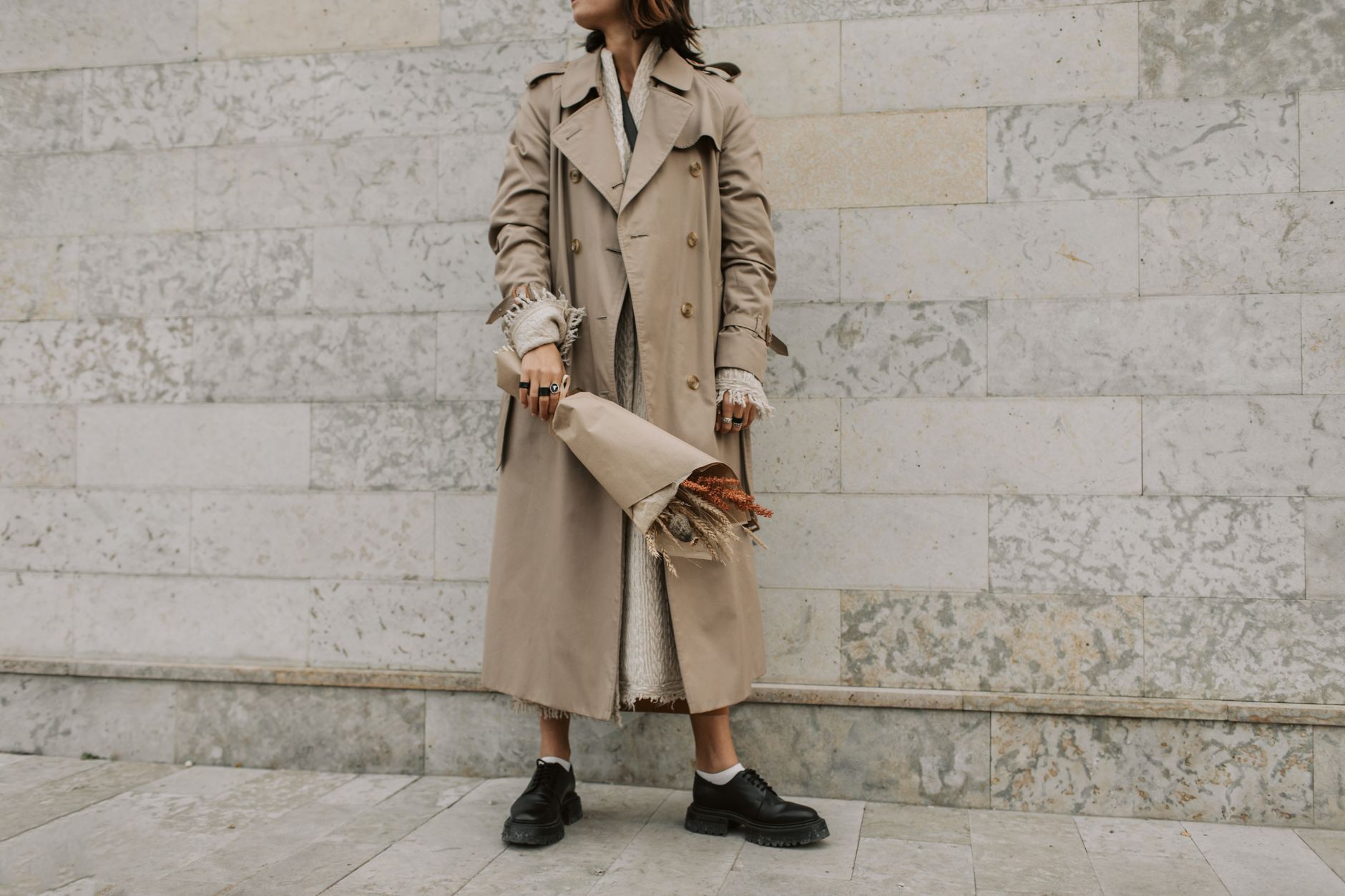
The outer shell is your armour. In the UK, this means something water-resistant more often than not. A classic mac from a brand like Barbour or a proper trench coat earns its place precisely because it handles rain without looking like you’ve come from a hiking trail. The key thing people miss: your shell needs to be long enough and loose enough to fit comfortably over both layers without pulling across the shoulders.

City-specific realities: Edinburgh vs Manchester vs London
These three cities are all in the same country and they dress completely differently for good reason. Edinburgh is genuinely cold for a significant chunk of the year, and the wind off the Firth of Forth is not messing about. If you’re spending any time in Edinburgh between October and April, a mid-layer that’s truly insulating, a down gilet under your mac, for instance, isn’t a luxury, it’s practical. The city also gets a lot of misty, damp cold that seeps through a thin coat faster than proper rain would.
Manchester runs warm and humid in summer in a way that catches people out. You’ll see tourists in full coats in July, confused about why they’re boiling. The city centre creates its own microclimate around the Arndale and Piccadilly, and afternoon rain is common enough that a packable waterproof in your bag is almost always worth it. A breathable outer layer is the move here, something like a lightweight waterproof shell that folds into its own pocket.
London is its own beast. It’s generally milder than the north, which leads to a different trap: under-dressing in early spring or late autumn because one warm day convinced you that winter was done. A linen blazer or unstructured jacket in the transitional months is a brilliant London piece, light enough for the warmth, structured enough for the office or an evening out.
What to look for in fabrics when layering outfits for British weather
Natural fibres perform better than synthetic blends in fluctuating temperatures. Cotton breathes, wool regulates, linen moves heat away from your body on warm days. Synthetic fabrics trap heat and moisture in ways that feel uncomfortable when the temperature swings quickly, which, as we’ve established, it always does.
This doesn’t mean you need to spend a fortune. Charity shops and second-hand platforms are genuinely brilliant for finding quality natural-fibre pieces. I’ve written before about how Oxfam and Barnardo’s have become serious fashion destinations, and for building a layering wardrobe on a sensible budget, they’re hard to beat. A good wool cardigan that would’ve cost £80 new turns up regularly for under a tenner.
Water resistance is worth paying for in your outer layer, but you don’t need it in everything. A good DWR (durable water repellent) coating on your shell coat is enough. Re-spray it once a season with a fabric water-repellent spray from Nikwax and it’ll see you through years of British drizzle.
The accessories that carry a layering outfit
A silk or satin scarf earns its place in any weather-ready wardrobe. Tied loosely, it adds warmth around the neck without the bulk of a knit. Folded into a bag, it weighs nothing. The same logic applies to a compact, fold-flat umbrella, the kind that fits into a structured handbag, which is non-negotiable if you spend any time outdoors in this country. Fulton make reliably solid ones and they’re widely available on the high street.
Shoes are where layering logic breaks down for a lot of people. You’ve built a considered outfit from the waist up and then put on trainers that soak through in ten minutes. A leather ankle boot or a rubber-soled loafer handles rain infinitely better and reads smarter. Off-duty style doesn’t have to mean uncomfortable, as NHS workers and healthcare professionals have been showing us for years. There’s a whole conversation to be had about how British healthcare workers are redefining practical off-duty dressing, and a big part of it comes down to footwear that handles real conditions.
Putting it together: the outfits that actually work
For a drizzly Edinburgh morning that might turn brighter: merino base layer, slim-fit straight trousers in a mid-weight fabric, a fine-knit mid-layer, and a belted trench over the top. Leather ankle boots. Compact umbrella in your bag. That outfit transitions from cold morning to a warmer afternoon with nothing more than losing the mid-layer.
For a humid Manchester afternoon: a breathable linen or cotton top, wide-leg trousers, and a packable waterproof shell that lives in your bag until the inevitable 3pm downpour. Light trainers if you’re walking a lot, but treat them with water repellent spray first.
For a London transitional day: unstructured blazer over a fitted base, tailored trousers, leather loafers. The blazer acts as your mid-layer and shell at once in the milder London climate. Clean, simple, infinitely adaptable.
None of this is complicated once you stop thinking in outfits and start thinking in systems. British weather isn’t going to get more predictable. Your wardrobe might as well be ready for it. Just like when you’re planning a home renovation and you realise some things, like having a professional handle asbestos removal mansfield, are worth doing properly from the start rather than improvising, building a genuinely weather-ready wardrobe is about getting the foundations right before you think about the finishing touches.
Buy fewer, better pieces. Layer deliberately. Keep a compact umbrella in every bag you own. You’ll look good and you’ll stop being surprised by the rain, which is the most British achievement possible.